


The main takeaway from my undergraduate degree in education at the University of Florida is “Teaching, is not really about teaching; Teaching is about learning to occur.” This is one of the reasons that when you ask either a teacher or an engineer what time it is, he or she starts by explaining to you how to make a watch. But the difference is, most engineers have probably actually made one before.
So, as we approach the gospel scripture today, I want to assure you it is as easy as A, B, C…
Saint Alban, Saint Brigid, and Saint Columba.
These are saints of our Anglican legacy in England, Ireland, and Scotland from 4th-6th centuries. They are as exemplars of obedience, preparation, action. These values we see elevated in today’s gospel reading. The Church in England which later became the Church of England was always part of the “one, holy, catholic, apostolic church”.
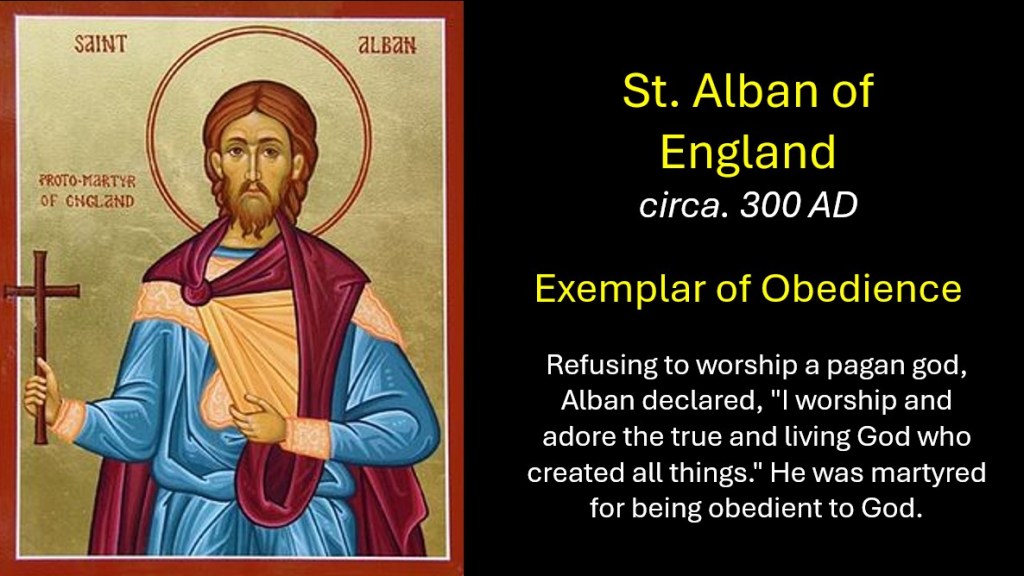
St. Alban was the first martyr in Britain, and had only been a convert for a very short time. In obedience to God, he refused to deny his faith in Jesus Christ as Lord and was killed for this refusal. Alban’s life was a great example of obedience regardless of the consequences.
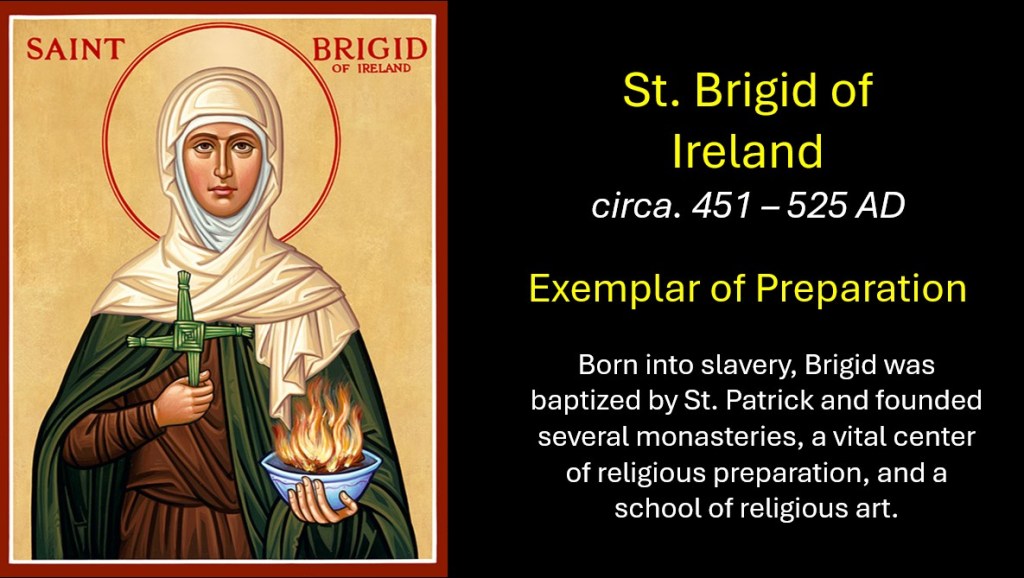
St. Brigid of Ireland founded several monasteries for men and women, a vital center of religious training and preparation, as well as a school of religious art. Brigid’s life was constantly lifting next generations and a wonderful example of then importance of preparation as an act of obedience.
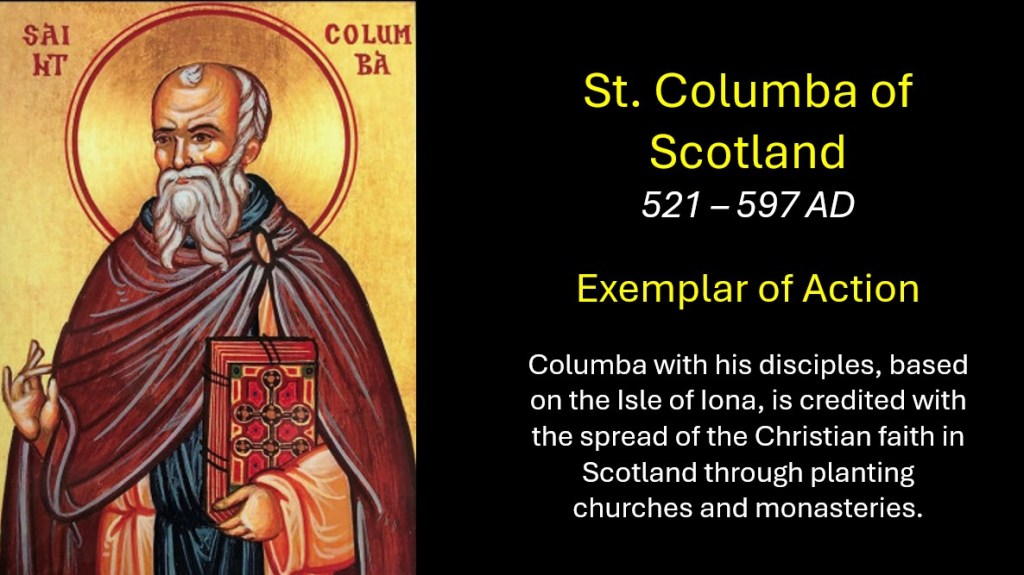
St. Columba was an Irish bishop who was exiled to Scotland, a wild untamed land at that time, as penance. Due to a dispute he had, there was a terrible battle for which he was partly responsible between two clans which took thousands of lives. As a consequence, Columba resolved in exile to win as many for Christ in Scotland as had perished in that battle. He was a man of action, who faithfully turned his mistakes into motivation.
In Luke 14:25-27 Jesus emphasizes intensely about putting our obedience to God above all else. Verse 26 uses a very unsettling Greek word “miseo” which is properly translated as “hate” “hatred”, or “detested”. The word miseō in Greek, or śā·nêʾ (saw-nay) in the Hebrew, describes holy outrage against the enemies of God: false gods, horrid atrocities, retched sins, threatening enemies. We are to hate those things which God hates, and love those things that God loves. He alone is God and there is none like him.
The word miseō in Greek, or śā·nêʾ (saw-nay) in the Hebrew, describes holy outrage against the enemies of God: false gods, horrid atrocities, retched sins, threatening enemies.
In Luke 14:26 a more literal rendering of what Jesus says here is, “If anyone comes to me and does not hate [“miseō”] his own father and mother and wife and children and brothers and sisters, yes, and even his own life, he cannot be my disciple.” Wow. Especially out of context, that verse is not one you want to have your children memorize. It’s always risky pull scripture out of the context of God’s great narrative.
There are two things that might help. First, let’s compare this scripture in Luke with a similar account of this teaching in Matthew. It is found in Matthew 10:37 and was likely spoken in a different setting where Jesus says: “Whoever loves father or mother more than me is not worthy of me, and whoever loves son or daughter more than me is not worthy of me.” Now, that scripture reminds us to love our families, but love God more. This is consistent with the teaching of Jesus to love your family, but love nothing more than God and in obedience, trust him.
Second, Jesus commonly uses a communication technique that we now call hyperbole which is statement to the extreme which has a powerful visual impact to make a point [such as ‘getting a camel through the eye of a needle’ or “faith to move a mountain” to emphasize having faith]. What is the main point Jesus is making in this extreme statement?
It’s very simple. Love nothing more than God. Have “no other gods” before the one true God revealed in Jesus. In obedience, we are to love and care for our families without turning them into idols. Idols are things that we actually try to control by our obsession of them and that’s not fair to anyone or anything. Only God is God.
But obedience alone is in itself, not enough. This moves us to our second passage. Obedience is almost always followed by preparation:
“But don’t begin until you count the cost. For who would begin construction of a building without first calculating the cost to see if there is enough money to finish it? 29 Otherwise, you might complete only the foundation before running out of funds, and then everyone would laugh at you. 30 They would say, ‘There’s the person who started that building and couldn’t afford to finish it!’ Luke 14:28-30
Abraham Lincoln once famously said, “Give me six hours to chop down a tree and I will spend the first four sharpening the axe.” Marva Sellers has moved to St. Augustine to help establish a Deaf Church in St. Augustine that serves the entire NE Florida region. It may seem like it came out of nowhere, but in reality, it is based on 10 years of preparation towards this moment.
Eugene Peterson describes a faithful church as a “A Long Obedience in the Same Direction” in how missional Christians “learn to grow in worship, service, joy, work, happiness, humility, community and blessing” by taking this kind of journey together. Obedience is a long process of preparation as part of our obedience to the Lord. We wait upon the Lord… but while are waiting, when take thousands of little steps in preparation. Even a small step in the right direction is progress. We are never to grow weary in our faithfulness to the Lord and we are to recognize the importance of going with others in the process. As the African saying goes, “If you want to go fast, go alone. If you want to go far, go with others.
“Blessed is the one who walks not in the counsel of the wicked, nor stands in the way of sinners, nor sits in the seat of scoffers; but finds delight is in the law of the Lord, and on God’s law he meditates day and night.” Psalms 1:1-2
Obedience, Preparation, Action: Obedience begats preparation begats action.
Luke 14:31-33 – “Or what king, going out to encounter another king in war, will not sit down first and deliberate whether he is able with ten thousand to meet him who comes against him with twenty thousand? And if not, while the other is yet a great way off, he sends a delegation and asks for terms of peace. So therefore, any one of you who does not renounce all that he has cannot be my disciple.”
Wise actions comes from thoughtful, prayerful discernment and preparation, but possibly most importantly, a decision is required for action to take place. Just like a countdown on a rocket launch, 5, 4, 3, 2,… if there is no “1”, there is no blastoff. It is just a very expensive vehicle sitting on a platform in Merritt Island. There has to be that moment of commitment that fulfills our obedience to the Lord, and is built upon years of preparation, there is that moment of decision. The Holy “Yes!” The green light, the starter flag. All we have waited for is found in faithfulness to our Lord Jesus Christ.
Karl Barth, who was arguably the most influential academic theologian of the 20th Century – not so much from his own work, but the remarkable theologians he influenced including Dietrich Bonhoeffer, which whom most of us are familiar. Writing about the Apostles Creed that begins with “I believe in Jesus Christ His Only Son, Our Lord, Barth writes: “With these words we step into the great center of the Christian Creed. And here decisions are made.”

Barth is right, Jesus Christ is where essential decisions are made about our life… who we are and whose we are. We need to ask ourselves: “Who is Jesus to me? Is he my Lord? Have I elevated anything in my life above him? Have I created idols that need to be removed?”
Here is some good news. You don’t have to walk through this life alone. Seek counsel. Send a delegation and ask for “terms of peace” in your heart. This may be a time of healing for you, or unexpected transition, or emotional struggling, or overwhelming financial stress. Being obedient for you might be learning how to say “no” and being okay with that. Preparation may be joining a weekly Bible Study group. Action might be decluttering life and giving yourself space from so many responsibilities and duties.
Where are you in your life? Is this a time of waiting in obedience, of patient preparation, or seeking counsel, or is it a time of bold steps forward, of action?” None of us can do everything, but all can do something that reflects God’s goodness and grace and truth for the sake of others.

See, today’s gospel scripture is as easy as A,B,C… obedience, preparation, action. And like St. Alban, St. Brigid, and St. Columba, we live as ordinary people who serve an extraordinary God.
Glory be to God, the Father, Son, and Holy Spirit and in the name of Jesus I pray. Amen
 Perspectives from R. E. Ayres