Obediance, Preparation, Action …Easy as A,B,C – Luke 14:25-33

The main takeaway from my undergraduate degree in education at the University of Florida is “Teaching, is not really about teaching; Teaching is about learning to occur.” This is one of the reasons that when you ask either a teacher or an engineer what time it is, he or she starts by explaining to you how to make a watch. But the difference is, most engineers have probably actually made one before.

So, as we approach the gospel scripture today, I want to assure you it is as easy as A, B, C…

Saint Alban, Saint Brigid, and Saint Columba.

These are saints of our Anglican legacy in England, Ireland, and Scotland from 4th-6th centuries. They are as exemplars of obedience, preparation, action. These values we see elevated in today’s gospel reading. The Church in England which later became the Church of England was always part of the “one, holy, catholic, apostolic church”.
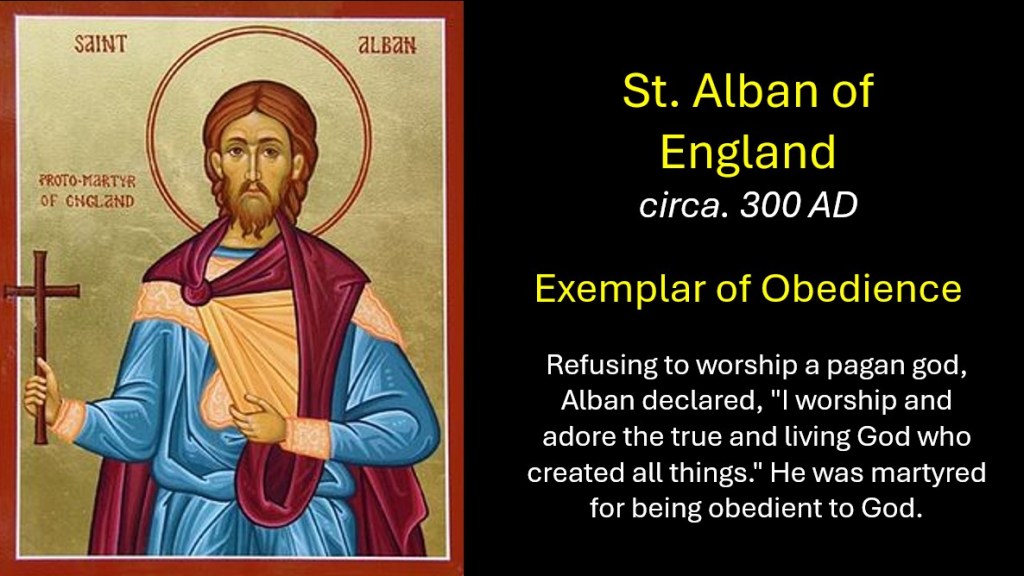
St. Alban was the first martyr in Britain, and had only been a convert for a very short time. In obedience to God, he refused to deny his faith in Jesus Christ as Lord and was killed for this refusal. Alban’s life was a great example of obedience regardless of the consequences.
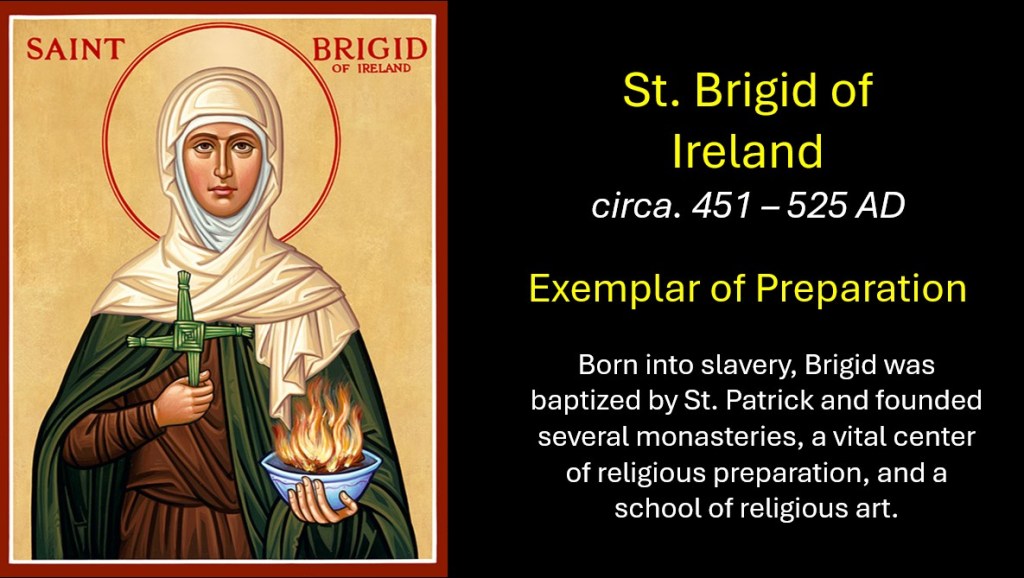
St. Brigid of Ireland founded several monasteries for men and women, a vital center of religious training and preparation, as well as a school of religious art. Brigid’s life was constantly lifting next generations and a wonderful example of then importance of preparation as an act of obedience.
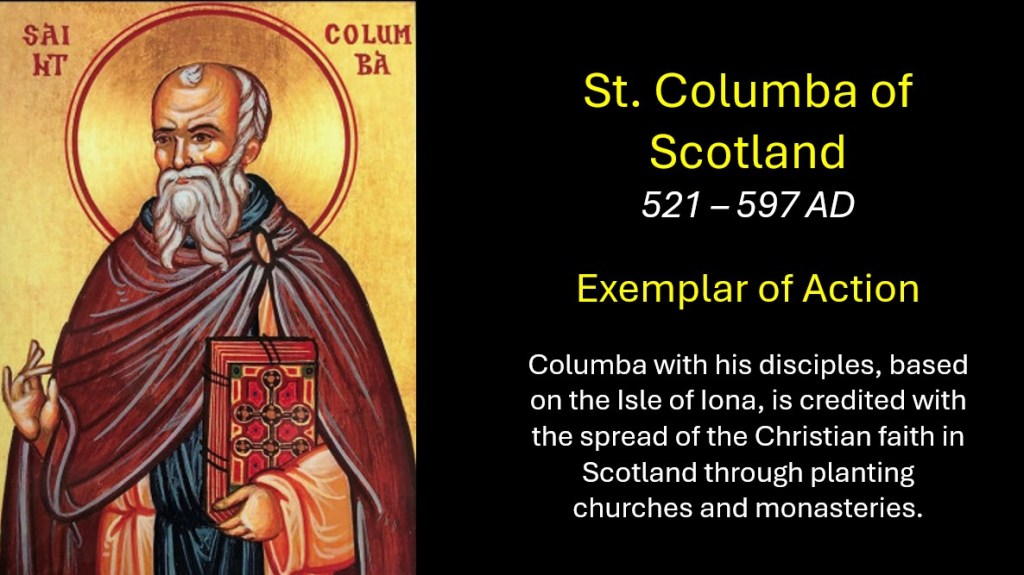
St. Columba was an Irish bishop who was exiled to Scotland, a wild untamed land at that time, as penance. Due to a dispute he had, there was a terrible battle for which he was partly responsible between two clans which took thousands of lives. As a consequence, Columba resolved in exile to win as many for Christ in Scotland as had perished in that battle. He was a man of action, who faithfully turned his mistakes into motivation.

In Luke 14:25-27 Jesus emphasizes intensely about putting our obedience to God above all else. Verse 26 uses a very unsettling Greek word “miseo” which is properly translated as “hate” “hatred”, or “detested”. The word miseō in Greek, or śā·nêʾ (saw-nay) in the Hebrew, describes holy outrage against the enemies of God: false gods, horrid atrocities, retched sins, threatening enemies. We are to hate those things which God hates, and love those things that God loves. He alone is God and there is none like him.

The word miseō in Greek, or śā·nêʾ (saw-nay) in the Hebrew, describes holy outrage against the enemies of God: false gods, horrid atrocities, retched sins, threatening enemies.

In Luke 14:26 a more literal rendering of what Jesus says here is, “If anyone comes to me and does not hate [“miseō”] his own father and mother and wife and children and brothers and sisters, yes, and even his own life, he cannot be my disciple.” Wow. Especially out of context, that verse is not one you want to have your children memorize. It’s always risky pull scripture out of the context of God’s great narrative.

There are two things that might help. First, let’s compare this scripture in Luke with a similar account of this teaching in Matthew. It is found in Matthew 10:37 and was likely spoken in a different setting where Jesus says: “Whoever loves father or mother more than me is not worthy of me, and whoever loves son or daughter more than me is not worthy of me.” Now, that scripture reminds us to love our families, but love God more. This is consistent with the teaching of Jesus to love your family, but love nothing more than God and in obedience, trust him.

Second, Jesus commonly uses a communication technique that we now call hyperbole which is statement to the extreme which has a powerful visual impact to make a point [such as ‘getting a camel through the eye of a needle’ or “faith to move a mountain” to emphasize having faith]. What is the main point Jesus is making in this extreme statement?

It’s very simple. Love nothing more than God. Have “no other gods” before the one true God revealed in Jesus. In obedience, we are to love and care for our families without turning them into idols. Idols are things that we actually try to control by our obsession of them and that’s not fair to anyone or anything. Only God is God.

But obedience alone is in itself, not enough. This moves us to our second passage. Obedience is almost always followed by preparation:

“But don’t begin until you count the cost. For who would begin construction of a building without first calculating the cost to see if there is enough money to finish it? 29 Otherwise, you might complete only the foundation before running out of funds, and then everyone would laugh at you. 30 They would say, ‘There’s the person who started that building and couldn’t afford to finish it!’ Luke 14:28-30

Abraham Lincoln once famously said, “Give me six hours to chop down a tree and I will spend the first four sharpening the axe.” Marva Sellers has moved to St. Augustine to help establish a Deaf Church in St. Augustine that serves the entire NE Florida region. It may seem like it came out of nowhere, but in reality, it is based on 10 years of preparation towards this moment.

Eugene Peterson describes a faithful church as a “A Long Obedience in the Same Direction” in how missional Christians “learn to grow in worship, service, joy, work, happiness, humility, community and blessing” by taking this kind of journey together. Obedience is a long process of preparation as part of our obedience to the Lord. We wait upon the Lord… but while are waiting, when take thousands of little steps in preparation. Even a small step in the right direction is progress. We are never to grow weary in our faithfulness to the Lord and we are to recognize the importance of going with others in the process. As the African saying goes, “If you want to go fast, go alone. If you want to go far, go with others.

“Blessed is the one who walks not in the counsel of the wicked, nor stands in the way of sinners, nor sits in the seat of scoffers; but finds delight is in the law of the Lord, and on God’s law he meditates day and night.” Psalms 1:1-2

Obedience, Preparation, Action: Obedience begats preparation begats action.

Luke 14:31-33 – “Or what king, going out to encounter another king in war, will not sit down first and deliberate whether he is able with ten thousand to meet him who comes against him with twenty thousand? And if not, while the other is yet a great way off, he sends a delegation and asks for terms of peace. So therefore, any one of you who does not renounce all that he has cannot be my disciple.”

Wise actions comes from thoughtful, prayerful discernment and preparation, but possibly most importantly, a decision is required for action to take place. Just like a countdown on a rocket launch, 5, 4, 3, 2,… if there is no “1”, there is no blastoff. It is just a very expensive vehicle sitting on a platform in Merritt Island. There has to be that moment of commitment that fulfills our obedience to the Lord, and is built upon years of preparation, there is that moment of decision. The Holy “Yes!” The green light, the starter flag. All we have waited for is found in faithfulness to our Lord Jesus Christ.

Karl Barth, who was arguably the most influential academic theologian of the 20th Century – not so much from his own work, but the remarkable theologians he influenced including Dietrich Bonhoeffer, which whom most of us are familiar. Writing  about the Apostles Creed that begins with “I believe in Jesus Christ His Only Son, Our Lord, Barth writes: “With these words we step into the great center of the Christian Creed. And here decisions are made.”

Barth is right, Jesus Christ is where essential decisions are made about our life… who we are and whose we are. We need to ask ourselves: “Who is Jesus to me? Is he my Lord? Have I elevated anything in my life above him? Have I created idols that need to be removed?”

Here is some good news. You don’t have to walk through this life alone. Seek counsel. Send a delegation and ask for “terms of peace” in your heart. This may be a time of healing for you, or unexpected transition, or emotional struggling, or overwhelming financial stress. Being obedient for you might be learning how to say “no” and being okay with that. Preparation may be joining a weekly Bible Study group. Action might be decluttering life and giving yourself space from so many responsibilities and duties.

Where are you in your life? Is this a time of waiting in obedience, of patient preparation, or seeking counsel, or is it a time of bold steps forward, of action?” None of us can do everything, but all can do something that reflects God’s goodness and grace and truth for the sake of others.

See, today’s gospel scripture is as easy as A,B,C… obedience, preparation, action. And like St. Alban, St. Brigid, and St. Columba, we live as ordinary people who serve an extraordinary God.

Glory be to God, the Father, Son, and Holy Spirit and in the name of Jesus I pray. Amen

President Biden’s Farewell Address

From Heather Cox Richardson, January 15, 2025 “Letters from an American”

https://open.substack.com/pub/heathercoxrichardson/p/january-15-2025?r=11ensy&utm_campaign=post&utm_medium=email

Much has been accomplished over the past four years. History will be kind to President Biden’s legacy.

Mutiny and Hope – a reflection on Genesis 3 by Nikki Smith

Every once in awhile, I’ll come across something in a book or sermon that just stuns me of how the ideas came together to convey deep insights with minimal words. At our church recently, we celebrated what is called “Lessons and Carols”, which is a service during the penitent season of Advent to reflect on the coming incarnation of our Lord. God entered a dark world in a unique way as the person of Jesus Christ, fully God, fully Human. Humanity is given new hope of a restored creation where God sets all things right, again.

This worship service communicates the biblical narrative primarily through scripture and songs with a few, brief meditations on the scripture throughout. They were all good and insightful presentations, but this one by Nikki Smith on our church staff struck me as rich theology captured in just a few hundred words. I asked for permission to share this on my blog for others to ponder as well. Just before Nikki gave this meditation, Genesis 3:1-15 was read.

I’m always intrigued by the idea of the Before Times: specifically the time before sin came into the world. What draws me into the creation story isn’t the explanation for why the world is the way it is, but the glimpse we get of something truly extraordinary before sin.

Our readings open just as the Trinity reaches into the dust and fashions a creature unlike any of the others he’s made so far. This creature, this human, He makes in His own image and gives His own breath – His very life. He then creates a woman from the same substance as man and places these images of Himself in the garden with a mandate to continue the work He began. We see Adam flourishing under this mandate, naming the creatures he meets and tending the garden; Eve joins with him and together, in fellowship with the Lord, they begin to establish the first culture.

That all this comes before sin enters the world is important because it shows us that human contributions to creation were good and culture was meant to grow and develop with human creativity leading the way. God’s creation, and therefore human creativity, before and apart from sin was entirely good. Humans were gifted with God’s image, His breath, fellowship with Him, and His blessing on their endeavors.

But then Adam and Eve throw it all away. They choose to take their destiny in their own hands, and in doing so, their ability to create thoroughly good things is lost. Their ability to work side-by-side with the Creator is taken away. The image of the Almighty in them is tarnished. Death came immediately. Not physical death, but the death of definitive human good, the death of Adam’s, Eve’s and – by extension – our relationship with God.

Our mutiny against the Creator’s order is the root cause of all the wrong we see and experience. We decided that God’s instruction wasn’t actually good at all. And in doing so we broke something precious and now all of creation groans. But even in our separation from God, He gives us a glimpse of something good to come: the serpent’s head will be crushed.

Nikki Smith – Meditation on Genesis 3:1-15

Hope starts a better day

Each day when we wake, we make a choice.

Do we first engage online social media platforms that are designed to draw us into concern, worry, paranoia, anger, even obsessive hateful thoughts?

Or do we look outside at the remarkable world God has created, thanking Him for another day of life, and turn our hearts towards expectancy and even a joy “that passes understanding”?

I fully realize that severe depression steals this choice from many; some very close to me. The choice here is often about seeking and getting the help necessary to survive day-to-day. Still there is a decision made and a truly heroic one as well: “I will embrace my life as it is this day and refuse to withdraw from those who love me.”

Life is not about choosing to be a “good” person or a “bad” person, we all are both. How we start our day can make a significant difference to how our day unfolds. Perspective is so often about attitude and decision. Choose today whom you will serve: worry or hope?

Hope is better. Attitudes matters. Think on those things that are excellent. And start early in the day.

Disinterested, Disillusioned, Distracted: Parable of the Sower

Matthew 13:1-9,18-23

That same day Jesus went out of the house and sat beside the sea.”

Matthew 13:1

Now whenever a passage of scripture begins with “therefore” or “after this” or in this case “that same day” then we are compelled to look back at what came before. It’s like walking into a conversation between your spouse and one of your kids, where the first thing you hear is “Well, in light of that new information, I guess we’ll just have to bail you out!” What? What happened. What went before scriptures like this often shed light on the context and emotion of the words.

So, glance back at Matthew, Chapter 12, and you’ll the day got off to a rough start. It began with Jesus and the disciples walking through a grainfield on the Sabbath and his disciples plucked some grain to eat. Jesus got blasted by the Pharisees. Then they all went synagogue and Jesus healed a man with a withered hand. Once again, he was verbally attacked by the religious leaders and they even conspired on how to destroy him.

Images from http://www.freebibleimages.org/

Wow! The day doesn’t seem to get much better from there: he heals a demon possessed man and is accused by this same group of critics that he was in league with the devil, which started an intense series of Jesus teaching about evil and unclean spirits, and the consequences of sin. Towards the end of this conflict, his family arrives outside while he was speaking intensely to these detractors. Jesus seems frustrated by it all and states, “My mother and my brothers and sisters?” Stretching his hand towards his followers he said, “Whoever does the will of my Father in heaven is my brother and sister and mother.”

Now, the scripture does not tell us, but I suspect Jesus did go out and spend some time with his family before he went down to sit beside the Sea of Galilee. I suspect this resulted in a calming effect from the earlier frustrations in his day. Jesus was not rejecting his family by his statement, he was making a point: a relationship with God is not about lineage or inheritance or being born into the right family, it is about transformational faith in response to God’s amazing grace.

Jesus went out of the house and sat beside the sea. Praying. Pondering. Processing all that happened so far that day. Probably glad to get some peace and quiet.

However…

v2 Great crowds gathered about him, so that he got into a boat and sat down. And the whole crowd stood on the beach.

Jesus cannot seem to get a break! I’m an introvert so I am obviously projecting into this narrative, but this has been an overwhelming morning, and now the crowd gathers again?

The crowd came, but this time, he has what seems to be a receptive audience, people hungry for truth and crowding together, listening to the One who has the words of life. I suspect he was energized by their openness and as always, responsive to their need.

“And he told them many things in parables, saying: “A sower went out to sow. And as he sowed, some seeds fell along the path, and the birds came and devoured them. Other seeds fell on rocky ground, where they did not have much soil, and immediately they sprang up, since they had no depth of soil, but when the sun rose they were scorched. And since they had no root, they withered away. Other seeds fell among thorns, and the thorns grew up and choked them. Other seeds fell on good soil and produced grain, some a hundredfold, some sixty, some thirty.”

Matthew 13:3-8

Later, when they asked Jesus why he speaks in parables and he answers, v13 “This is why I speak to them in parables, because seeing they do not see, and hearing they do not hear, nor do they understand.

Jesus is likely referring here to the hearts of these religious leaders whose lives had become filled with anger, pride, and judgmentalism. They think they see, because they are learned and respected men; they think they hear, because they have sat at the feet of famous preachers and are they themselves are teachers of others, they think they understand the Law and Prophets, but miss God’s redemptive narrative throughout the entirity of Holy Scripture.

What is missing in their lives is a “good soil” attitude where the word of God can be planted, nurtured, and able to produce an abundant harvest. But the crowd is curious and open to learn. All of Jesus’ parables in Matthew 13 are about the Kingdom of Heaven.

Jesus explains the four responses described in the parable:

[Jesus] v19 When anyone hears the word of the kingdom and does not understand it, the evil one comes and snatches away what has been sown in his heart. This is what was sown along the path.

What Jesus describes here is the hardened heart of the Disinterested.

[Jesus] v20-21 As for what was sown on rocky ground, this is the one who hears the word and immediately receives it with joy, yet he has no root in himself, but endures for a while, and when tribulation or persecution arises on account of the word, immediately he falls away.

Here we see the unreliable mind of the Disillusioned.

[Jesus] v22 As for what was sown among thorns, this is the one who hears the word, but the cares of the world and the deceitfulness of riches choke the word, and it proves unfruitful.

I see this as the confused emotions of the Distracted.

Disinterested, Disillusioned, Distracted… hardened path, rocky soil, thorns that choke…

Before we let ourselves begin to think of various friends and family, let me challenge you, as I challenge myself, to ask the hard questions: Where am I falling short? Does this parable resonate with various parts of my own faith journey?

In my life, am I sometimes disinterested in a word from the Lord? Where has God’s message of grace and truth been scattered on the hard paths of my heart? Do I care about the things that God cares about? Is there rocky ground in my mind that confuses and weakens my commitment? Am I more interested in being liked than I am in being honest about my perspectives? Am I distracted by the world; confused by messages in our society regarding what’s right and wrong? Am I maintaining a clear understanding of grace and truth? Am I falling into unnecessary legalism and judgmentalism while holding on to biblical truths?

So, what are the responsive actions of the Devoted?

[Jesus] v23 As for what was sown on good soil, this is the one who hears the word and understands it. He indeed bears fruit and yields, in one case a hundredfold, in another sixty, and in another thirty.

This is not a calling to “good works” in order to earn favor with God. Quite the opposite! In this parable, the faithful one who hears the message, understands what it means, and simply lives this way, bears fruit. This person’s role is simply to prepare “good soil” for God to do the work of bearing fruit and yields. Here we observe the responsive actions of the Devoted.

Our Old Testament reading in Isaiah gives us insights into God’s initiative and our response, using this imagery: “For as the rain and the snow come down from heaven and do not return there but water the earth, making it bring forth and sprout, giving seed to the sower and bread to the eater, so shall my word be that goes out from my mouth; it shall not return to me empty, but it shall accomplish that which I purpose, and shall succeed in the thing for which I sent it.”

Isaiah 55:10-11

It is God who does the work, we simply respond by preparing the soil.

[Jesus] v23 As for what was sown on good soil, this is the one who hears the word and understands it. He indeed bears fruit and yields, in one case a hundredfold, in another sixty, and in another thirty.

Today’s epistle reading in Romans says v15-16 “You have not received a spirit that makes you fearful slaves. Instead, you received God’s Spirit when he adopted you as his own children. Now we call him, “Abba, Father.” For his Spirit joins with our spirit to affirm that we are God’s children.”

Kathy and I have six adopted children who between them, have given us twelve delightful grandchildren (the reward for having survived parenting). We adopted them all as older children and raised five of the six. The last one was an informal adoption when he was already an adult, but he is fully part of the family.

We like to say we have really great kids who were born into very difficult situations. They are fully and 100% our children, just as if Kathy had given birth to them. They are our children. Their children are our grandchildren. We love them all deeply. By the way, no NFL linemen in the bunch.

Each one has emotional struggles to overcome from early childhood experiences of abuse, neglect, or institutional life. During the most difficult times, by the power of Christ in us we told them and hopefully showed them that we can “love you longer than you can stay angry, deeper than you can hurt, and farther than you can run.” This is just what loving parents do.

We can “love you longer than you can stay angry, deeper than you can hurt, and farther than you can run.” This is just what parents do. We are ordinary people who serve the most extraordinary God.

It only makes sense because our Heavenly Father has loved us, and accepted us while we were still sinners, and has adopted us into his family as full heirs of his promise. Now we call him, “Abba, Father.”

You remember the Disinterested, Disillusioned, Distracted? They too need to know about the grace and truth of Jesus Christ.

There seem to be more of them every day. Maybe through lots of prayer, simple acts of kindness, and honesty about what we have seen, learned, or personally experienced, and prepare “good soil” in our lives, I believe we’ll even begin to see changes in the lives of those around us.

The hardened heart of the Disinterested might become the inspired heart of a seeker. The unreliable mind of the Disillusioned could become the committed mind of a new believer. The confused emotions of the Distracted may become the dependable feelings of someone wanting to be mentored.

Everything the world needs, we have to offer: community, friendship, forgiveness, purpose, hope, encouragement, instruction, understanding, a place to serve, eternal life. This is all only possible through the sacrifice of our Lord Jesus Christ.

Photo by Jill Wellington on Pexels.com

Stranger things have happened. I too was once lost, but now am found; was blind, but now I see. It was because of the responsive actions of the Devoted… people like you, who showed up in my life, inviting me to learn more about the God who offers for us to know him as “Abba, Father.”

He is the Lord of the harvest. We are just workers in the field preparing the soil.

In the name of God the Father, Son, and Holy Spirit. Amen.